Arizona Businesses Have a New Energy Question: Can You Get Enough Power?
For years, the commercial solar conversation usually began with one question:
How much money could solar save us?
That question still matters—but for many Arizona businesses, it is no longer the first or most important energy question.
Today, the conversation may need to begin here:
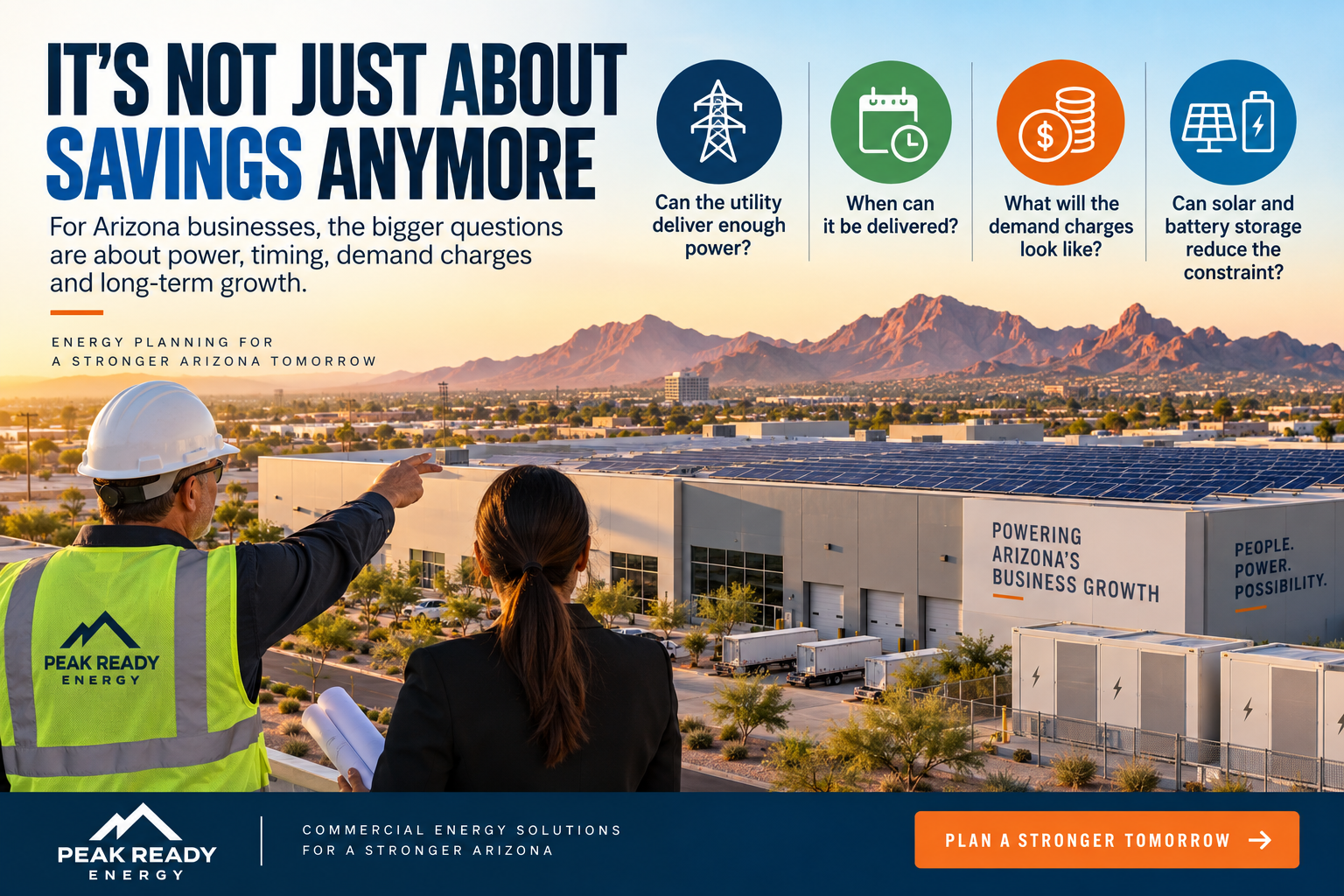
Can the utility deliver enough power for your facility, when can it be delivered, what will the demand charges look like, and can solar plus battery storage reduce the constraint?
For commercial property owners, developers, manufacturers, fleet operators, cold-storage facilities, data-intensive businesses and other growing operations, access to electricity can directly affect where they locate, when they open and how quickly they can expand.
Energy planning is becoming a business-capacity decision—not simply a utility-expense decision.
Economic Growth Requires More Power
Arizona continues to attract businesses with significant electrical requirements. Advanced manufacturing, semiconductor operations, warehouses, automated distribution facilities, artificial intelligence infrastructure, electric vehicle charging, refrigeration, commercial HVAC and other modern systems can place substantial demands on the electrical grid.
A company may find the right building, negotiate acceptable lease terms and establish an aggressive opening schedule—only to discover that the property does not currently have enough available electrical capacity.
Resolving that limitation could require:
A larger utility service
A transformer upgrade
New switchgear
Additional distribution infrastructure
Utility engineering and construction
Municipal permitting and inspections
A longer energization schedule than the business anticipated
The problem is not necessarily whether power can eventually be provided. The more immediate question is whether it can be provided in the amount and timeframe the business requires.
A delayed utility upgrade can postpone equipment installation, tenant occupancy, production, revenue and business expansion.
Four Questions Every Arizona Commercial Project Should Ask
Energy planning should begin early—preferably before a property is purchased, a lease is signed or major equipment is ordered.
1. Can the utility provide enough power?
The building’s existing electrical service may not support the company’s planned operations.
Businesses should evaluate their current and anticipated electrical loads, including HVAC, production equipment, refrigeration, computing infrastructure, vehicle charging and future growth. The analysis should also consider whether the facility’s transformer, service entrance, panels and switchgear are adequate.
2. When can the power be delivered?
Electrical capacity and energization schedules are different issues.
Even when an upgrade is possible, utility engineering, equipment availability, infrastructure construction, permitting and interconnection requirements may affect the timeline.
A realistic time-to-power assessment can help a business determine whether the site and project schedule are compatible.
3. What will the power cost?
A commercial electric bill is not determined solely by the total kilowatt-hours consumed.
Many businesses are also affected by demand charges based on their highest measured level of electrical demand during a billing period. A short period of unusually high usage can influence a meaningful portion of the monthly bill.
Businesses adding large equipment, cooling systems or vehicle charging should understand how the new load may affect both total energy consumption and peak demand.
4. Can solar and battery storage improve the outcome?
Solar and battery storage cannot eliminate every utility-capacity limitation, and every property must be evaluated individually. However, they may become part of a broader solution.
Depending on the facility, rate structure, operating schedule and utility requirements, solar and storage may help:
Reduce electricity purchased from the grid
Lower certain periods of peak demand
Manage the timing of energy use
Support planned load growth
Improve resilience for selected critical operations
Reduce exposure to future utility-cost increases
Allow a business to use available electrical capacity more strategically
This is a much broader value proposition than calculating the simple payback period for rooftop solar.
Solar Is Only One Part of the Energy Strategy
A commercial energy assessment should not begin with the assumption that every property needs solar or that the largest possible system is automatically the right answer.
The process should begin with the business.
What equipment must operate? When does it operate? How quickly will the company grow? Which electrical loads create the highest peaks? Which operations are critical during an outage? What capacity is available today—and what may be required three, five or ten years from now?
From there, the potential solution may include a combination of:
Utility service coordination
Load analysis and energy-efficiency improvements
Operational changes or managed loads
Rooftop or carport solar
Battery energy storage
Backup-power planning
Switchgear and electrical infrastructure upgrades
Phased energy improvements aligned with business growth
The objective is not simply to install equipment. It is to develop an energy strategy that supports the property and the organization using it.
A Better Question Than “What Is the Solar Payback?”
Traditional solar ROI remains important. Businesses should understand expected production, incentives, operating savings, financing costs and projected returns before making an investment.
But financial return should be evaluated alongside the operational value of having sufficient, affordable and dependable power.
For some companies, the largest economic benefit may not be the reduction shown on the utility bill. It may be:
Opening a facility sooner
Avoiding an unsuitable building
Supporting additional production equipment
Expanding without creating a new electrical bottleneck
Managing demand created by fleet charging
Protecting critical business functions
Improving the long-term marketability of a commercial property
Those benefits can be significantly more valuable than traditional solar savings alone.
Evaluate Power Before It Becomes the Project Constraint
Electrical capacity should not be treated as a final construction detail. It should be evaluated as part of site selection, lease negotiations, facility design, capital planning and operational growth.
Before committing to a major Arizona commercial property or expansion, decision-makers should understand:
The facility’s current electrical capacity
The projected load after occupancy or expansion
The utility’s preliminary upgrade requirements and timeline
The applicable rate structure and potential demand charges
The role solar, storage and load management could play
The financial and operational consequences of a delay
Peak Ready Energy helps Arizona commercial property owners and businesses evaluate these questions before energy availability becomes an expensive surprise.
Can the utility get you enough power? When can you get it? What will the demand charges look like? Can solar and storage reduce the constraint?
Those may now be the most important questions in Arizona commercial energy planning.
Start With a Commercial Energy and Time-to-Power Assessment
Planning a new facility, expansion, major equipment addition or commercial development in Arizona?
Peak Ready Energy can help you evaluate the property’s electrical requirements, potential utility constraints and opportunities for solar, battery storage and demand management.
Request a commercial energy and time-to-power assessment.
Every facility, utility service territory, rate plan and energy project is different. Any potential savings, capacity benefits, resilience capabilities or project timelines must be confirmed through site-specific engineering, utility coordination and financial analysis.
