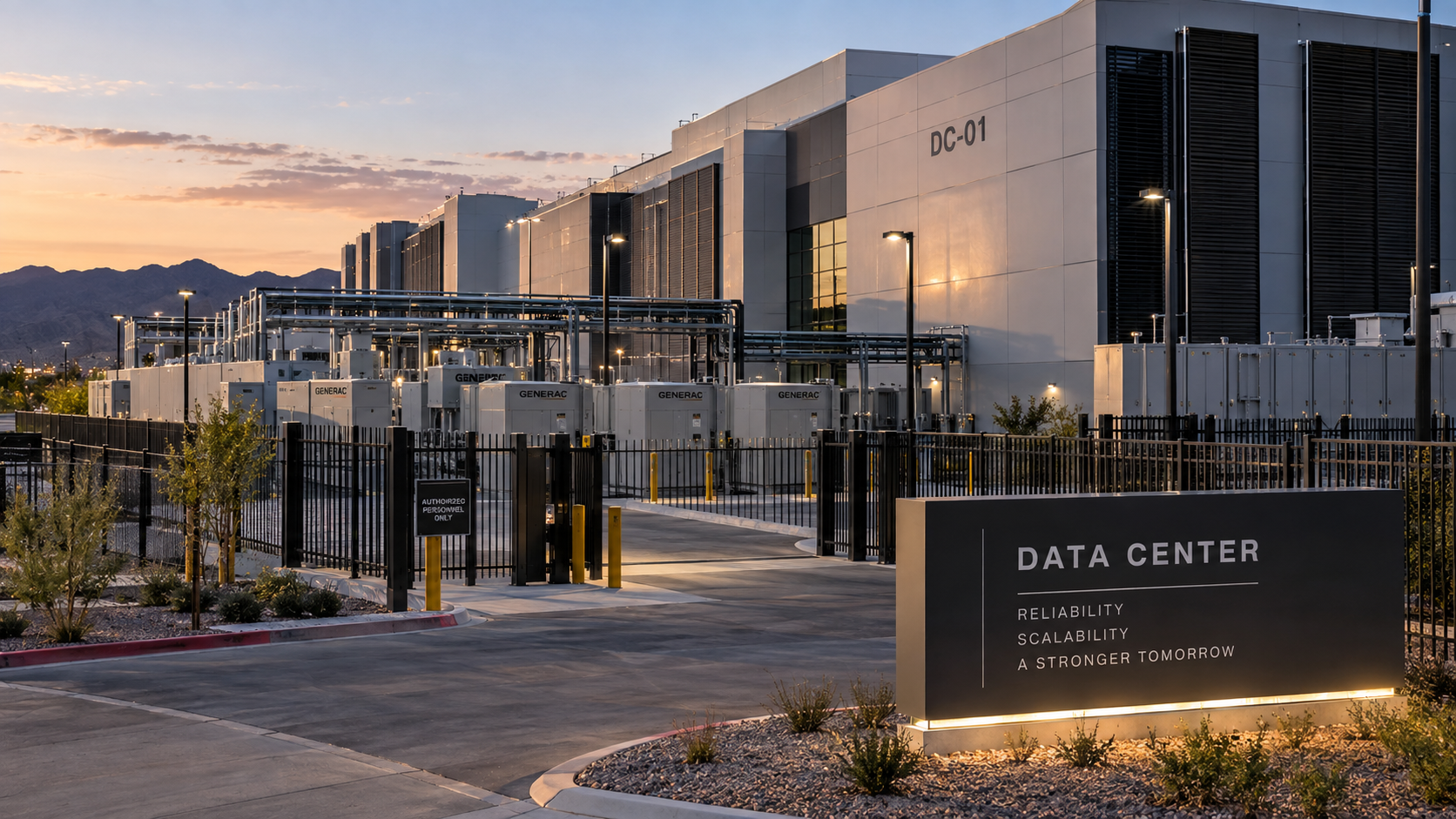
Data Centers / Large Loads / Time-to-Power
Large-load development increasingly depends on one question: can the utility deliver the required power when the project needs it? Peak Ready helps Arizona businesses organize preliminary capacity, interconnection, infrastructure, schedule, integrated-resource and economic decisions before site, lease, equipment or construction commitments are locked in.
Power availability is only part of the equation. We also evaluate who may be responsible for utility upgrades, how tariffs and cost-allocation decisions can affect project economics, and whether a phased onsite-power strategy can shorten the path to operation. That strategy may combine generation, fuel planning, switchgear, battery storage, solar, load management and staged utility service—without treating any one technology as the entire answer.
MARKET SIGNAL: AMAZON–GENERAC DATA-CENTER POWER AGREEMENT
Amazon Data Services’ newly announced long-term agreement with Generac—covering approximately $2.4 billion of large-generator equipment expected for 2027–2028 and potentially expanding with future purchases—underscores how quickly dependable onsite power is becoming a core data-center development requirement. The practical lesson for Arizona owners is not to default to one vendor or one technology. It is to evaluate generator availability, fuel strategy, emissions and permitting, switchgear, controls, batteries, solar, utility capacity and phased energization as one coordinated time-to-power plan.
POWER AVAILABILITY • PROJECT READINESS • ARIZONAPower Readiness for Large-Load Projects
-
Designed for smaller, distributed computing environments—not hyperscale campuses. Pair on-site solar with battery storage, controls and generator coordination to reduce demand exposure and keep critical racks, networking and cooling priorities supported during disruptions.
-
Support robotics, process controls, compressed-air systems, refrigeration and production equipment with a facility-specific mix of solar, battery storage and energy controls. Reduce peak demand while improving operational resilience.
-
Lower daytime utility purchases, control expensive peaks and provide backup support for servers, communications, security and essential workplace systems. Solutions are sized around business continuity and financial performance.
-
For telecom rooms, remote processing sites, logistics nodes and other distributed infrastructure, combine local generation, storage and load prioritization to reduce outage exposure and keep essential digital services operating.
Request a Time-to-Power Assessment
We evaluate planned load, existing service, available utility information, upgrade and interconnection paths, transformer and switchgear status, service-entrance and distribution needs, procurement risk, phased energization, solar, storage, backup generation, load management, resilience and the cost of waiting for power.
BUILT FOR POWER-CONSTRAINED DEVELOPMENT
Data centers and AI/compute facilities; advanced manufacturing and industrial facilities; high-load warehousing and distribution; EV and fleet charging; large commercial developments; cold storage; and high-load HVAC or process facilities.
UTILITY-UPGRADE COST RESPONSIBILITY
A capacity answer is incomplete without understanding potential cost allocation. The assessment identifies known and unresolved exposure involving feeders, substations, transformers, switchgear, service extensions, interconnection work, deposits, tariffs and phased-service requirements. Final costs and responsibilities remain subject to utility studies, tariffs, agreements and qualified review.
WHY PROJECTS STALL
Utility capacity limitations, interconnection queues, feeder or substation constraints, transformer and switchgear lead times, rapidly changing load requirements and financing exposure caused by energization delays can become critical path risks. Peak Ready evaluates preliminary phased and hybrid strategies so owners can compare schedule, cost, resilience and operating tradeoffs before committing.
CLEAR PROFESSIONAL BOUNDARIES
Peak Ready provides preliminary advisory, assessment and project-navigation support. Utility studies and approvals remain with the serving utility. Licensed engineering, EPC, contracting, permitting and construction responsibilities remain with the appropriately qualified providers. Peak Ready does not guarantee capacity, interconnection timing, savings or an energization date.
REQUEST A TIME-TO-POWER ASSESSMENT
One Project. One Integrated Power Strategy.
Compare solar, battery demand management and combined savings.
OPEN CALCULATOR-
See annual utility savings, demand-charge reduction, tax and incentive assumptions, cash-versus-financing results, payback, estimated 20–25 year value, roof and lease considerations, and end-of-term exposure. The decision is framed around NOI, risk, tenant appeal and long-term property value—not panel count.
-
Map critical loads, outage priorities, peak-demand windows, cooling and process constraints, switchgear, maintenance access and installation disruption. The operating plan identifies what remains powered, for how long, who owns each task and how commissioning and monitoring will work.
-
Most solar sellers begin with equipment. Peak Ready begins with the decision: utility data, property facts, critical loads, photos, timeline, budget and financing preferences are organized into a complete, qualified, appointment-ready customer file. Licensed contractors remain responsible for final design, permitting, code compliance, pricing and installation.